
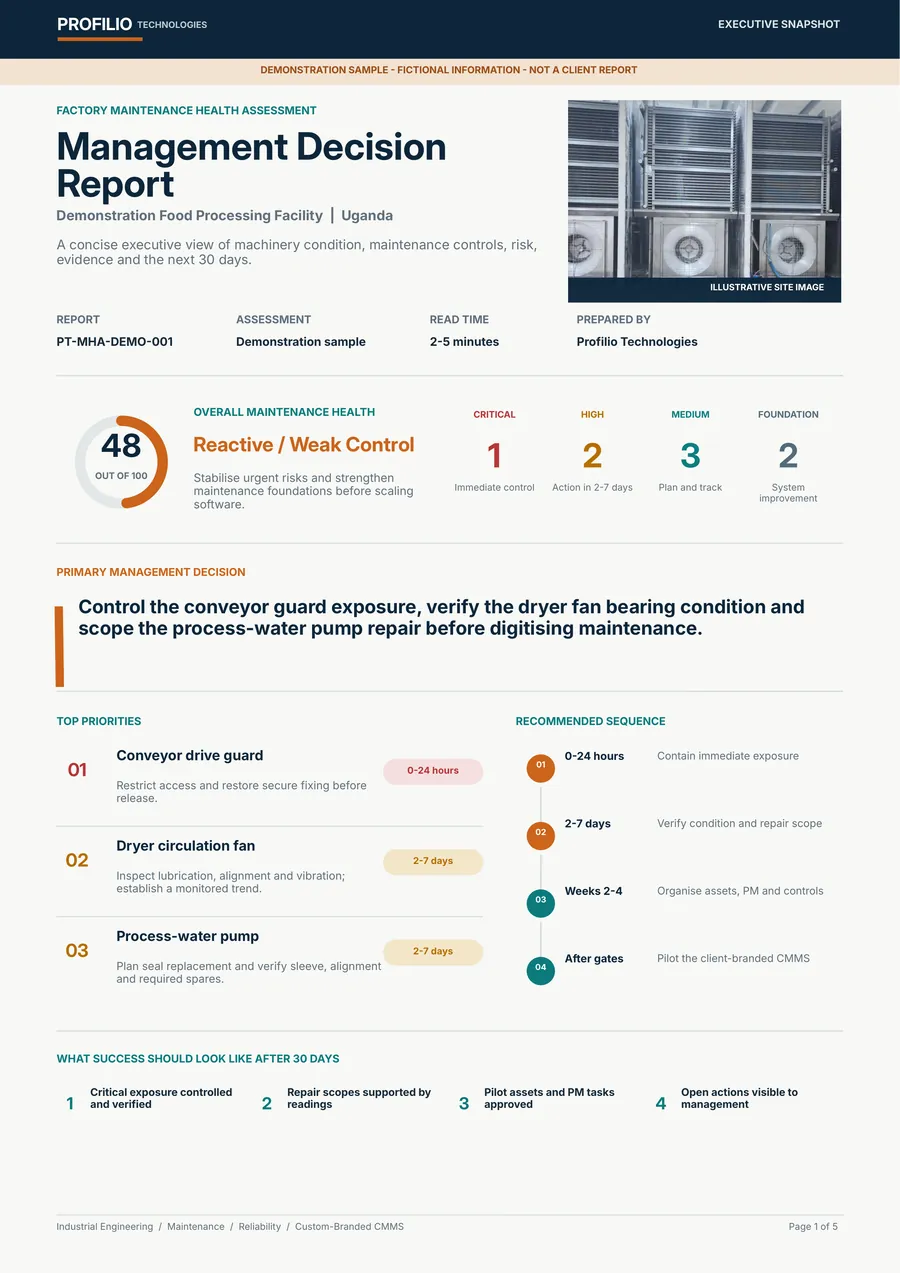
Fictional demonstration assessment — shown in the format of a Profilio client-review deliverable. No real client data is used. Both documents use fictional demonstration information. The site, company, asset, and every recorded result are invented for demonstration.
What this demonstration does and does not prove
It demonstrates the report architecture, the decision logic, the traceability from evidence to finding, the way operating consequence is framed, how the decision is presented to management, and how action and verification are tracked separately.
It is not a real client engagement, a real measured client outcome, a testimonial, audited financial performance, or statutory certification. No verified Profilio client outcome is published anywhere on this website yet.
Two documents, two readers
The reporting system separates rapid management reading from detailed engineering evidence. Both documents carry the same report reference, so every management statement can be traced back to the engineering record that supports it.
Executive Assessment Report — 7 pages
Written for the owner, CEO, managing director, plant manager, or engineering manager. It answers:
- what is wrong;
- what matters most;
- what the operating consequence is;
- what decision is required;
- what action state each item is in;
- what verification state each item is in.
It opens with a one-minute first page: the assessment conclusion, completion, findings, open actions, and the highest unresolved recorded risk. A decision dashboard then ranks findings by severity and consequence exposure and separates action status from verification status.
Technical Annex — 11 pages
Written for the engineering or maintenance reviewer who has to act on the report. For each item it records:
- the evidence and its source;
- the observation or finding;
- the severity;
- the operating consequence;
- the recommendation;
- the corrective action;
- the verification criteria and their current status.
The annex protects engineering depth without overcrowding the management report. It records the assessment framework and question set, the methodology, section-by-section results, and a closing traceability table binding every finding to its evidence class, action, and verification state.
Evidence discipline
The reporting framework distinguishes measured readings, observed judgements, documented or record-derived information, calculated values, client-provided information, estimated information, and evidence that is not established. Where the recorded evidence does not support a severity rating, the demonstration reports it as not established rather than rounding it up or down.
Recovered productive capacity is not automatically called revenue, and an engineering saving is not automatically called realised profit. The demonstration records the kind of exposure — reliability, capacity, cost, maintenance, engineering, operational — without calculating or claiming a monetary value anywhere in the report.
What this says about the reporting capability
Both documents were produced deterministically from controlled assessment data in Assessment Studio. The controlled reporting capability that generates this paired deliverable is proven and demonstrable today, within the Factory Maintenance Health Assessment route.
That proof is specific. It does not extend to unrestricted production deployment of the wider maintenance platform, hosted or multi-tenant operation, broad integrations, synchronisation, or future operational-intelligence modules — those remain controlled by module readiness evidence and written scope.
A live report depends on the agreed site scope, safe access, records available, interviews, verified machinery condition, specialist boundaries, travel, and confidentiality requirements.